

Dental Home Care
Dental Home Care
The Tooth, the Whole Tooth and Nothing but the Tooth
In this picture we see the crown of the tooth (the part we see when looking in the mouth), the root of the tooth (the part we do not see), and the attachment of the tooth to the bone. The tooth sits in a “socket” and is held there by periodontal ligaments.
The tooth receives nutrients from blood vessels inside the pulp chamber of the tooth. Periodontal disease takes place inside the socket in which the tooth is seated.
Out of all the members of one’s family, the chances are it will not be difficult to guess who has the worst dental hygiene: the pets. They do not brush their teeth nor do they floss and this goes on for years. If you are ever curious as to what happens if teeth go for years without brushing (or you want to show your children what will become of their teeth should they fail to brush regularly), you have only to look at your pet’s teeth and smell your pet’s breath.

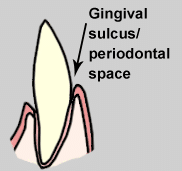
In a normal mouth, the teeth are clean and white and the gums attach smoothly to the tooth. There is no redness or tartar. The tooth is bathed in saliva, bacteria, and food particles (plaque) but if this is brushed away, it never mineralizes into tartar.
If we do not regularly disinfect our mouths and brush away the plaque, the plaque will mineralize into tartar (also called calculus – gritty material that the dental hygienist scrapes away). Tartar is solid and gritty, and blocks oxygen from bathing the outer tooth and thus MarVistaVet) changes the nature of the bacteria that can live around the tooth. Inflammation and tenderness result in the gingival sulcus.
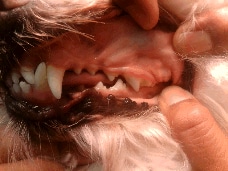
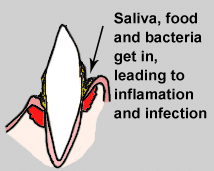
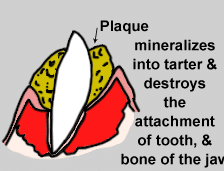
Tartar builds up covering most of the crown of the tooth as well as the attachment of the tooth root below the gum.
Worse still, the bacteria of the mouth can seed other areas in the body leading to infection in the heart, liver, kidney or virtually anywhere the bloodstream carries them.
In short, if regular home care is not performed on teeth, plaque will mineralize in the gingival sulcus, accumulate and destroy the attachment of the tooth. The tooth will be lost and the jaw bone can potentially break or even disintegrate (a serious problem in very small dogs). Worse still, the bacteria of the mouth can seed other areas in the body leading to infection in the heart, liver, kidney or virtually anywhere the bloodstream carries them.
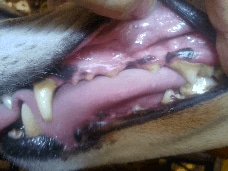
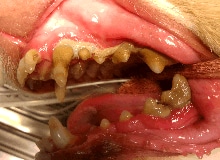
Gingivitis is reversible. Bone loss, once it starts, is not reversible.
What to do about Periodontal Disease
Fortunately, there is a lot we can do to prevent periodontal disease and the rules are basically the same whether the teeth belong to a pet or to a human being: Professional Cleaning and Home Care. Expect your pet to need a professional teeth cleaning every 6-12 months and expect general anesthesia to be necessary for each tooth to receive proper attention and care. Home care is ideally a daily part of tooth maintenance but even brushing just twice a week can remove most plaque before it can mineralize into tartar. Not every pet is amenable to hands-on oral care and not every person’s schedule is amenable to it either so there are some lower maintenance options which we will review as well.
Be sure to look at the back teeth as this is where tartar is usually the heaviest. If you see tartar deposits, it is probably time for a professional teeth cleaning.
Regular Professional Cleaning
It should not be surprising that dental health requires periodical professional cleaning regardless of whether the mouth in question belongs to a person, a dog, a cat, a horse, or some other animal. Home care of the tooth is never perfect and periodically tartar must be properly removed and the tooth surface properly polished and disinfected. The professional cleaning performed at the veterinarian’s office is similar to what a person receives at their dentist’s office:
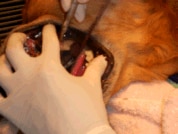
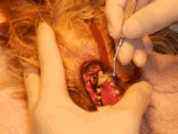
More delicate tartar deposits are removed from the gum line with other dental instruments.
Periodontal sockets are probed and measured to assess periodontal disease.
The roots are planed, meaning tartar is scraped from below the gum line until the roots are smooth again.
The mouth is disinfected and possibly treated with a fluoride sealer or plaque repellent.
Professional notes are taken on a dental chart, noting abnormalities on each of a dog’s 42 teeth or a cat’s 30 teeth.
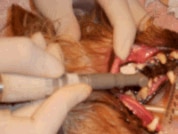
Important: It is important to note that “non-anesthetic” teeth cleaning is not comparable to the above service. It is not possible to perform the multi-step cleaning in a pet without general anesthesia.
Cosmetic cleanings do not address periodontal disease where it occurs: under the gum line.
Home Care and Products
Toothpaste and Brushing
Notice the shape of the canine and feline brushes and how they conform to a pet’s mouth. You can use a human toothbrush but you will probably find it difficult to manipulate in the pet’s mouth. Never use a human toothpaste for a pet as these contain sudsing agents (people like to see foam when they brush their teeth) which are not meant to swallowed in quantity. Animal toothpastes come in special flavors (chicken, seafood, and malt) in addition to the more human-appreciated mint and all are expected to be swallowed. Finger brushes are available and are smaller for puppies and kittens.
Do’s and Don’ts of Brushing your Pet’s Teeth
- Don’t use a human toothpaste on your pet.
- Do use a toothbrush without any paste at first so that your pet may get used to the object in the mouth before having to contend with flavor.
- Don’t attempt to clean the inner surface of your pet’s teeth. Natural saliva cleans this surface on its own.
- Do try to perform dental home care at least once daily.
- Don’t perform dental home care during the first week after a full dentistry in the hospital as your pet’s gums may be tender.
- Don’t consider dental home care as an alternative to full dental cleaning if your pet has more advanced dental disease.
Dental Wipes, Rinses and Pads
Some animals, especially those with tender gums, will not tolerate brushing but are more amenable to disinfecting wipes or pads. These products will wipe off plaque deposits from the surface of the tooth and, though they lack the ability to pick food particles out of the gum socket, they are probably the next best thing to brushing and, like brushing, these products are best used daily.
OraVet® Plaque Preventive Gel
This product addresses the convenience factor of pet dental care. Doing anything in a pet’s mouth daily year after year is a difficult habit for most people to establish. We have enough trouble taking care of our own teeth. Oravet is a wax-like substance applied once a week to the outer surface of the teeth with a swab (though it can be used even daily for pets with particularly bad gingivitis). Oravet prevents plaque from attaching to the tooth and provides a helpful mode of dental care on an easy to follow schedule.
Dental Treats
For many people, doing anything inside their pet’s mouth on a regular basis is simply never going to happen. Fortunately, all is not lost: chewing on a proper dental chew daily can substantially reduce plaque and tartar by up to 69%. Chews should be used dally In order to achieve these results; occasional use is not going to be helpful and the dog must actually chew on the treat.
Dental chews must be the proper size for the dog in question to avoid a choking hazard and can have sophisticated additional ingredients. Examples include ingredients to prevent mineralization of plaque (i.e. hexametaphosphate in C.E.T. Dentahex chews) or to prevent future plaque attachment after current plaque is rubbed off (delmopinol in Oravet brand chews), and green chlorophyll to help with bad breath.
Dental Diets
There is a common misconception that simply feeding a kibbled diet will protect the teeth from dental disease. Conslder what it would be like to attempt to replace brushing your own teeth with eating crunchy foods and it is easily see how ineffective this method would be. When it comes to pet foods, much ofthe kibble is swallowed whole and not chewed at all.
Clearly, there must be more to a dental diet than simple kibbling and in fact there is. Dental diets on the market today use several techniques to help reduce plaque. The first is that the kibbles are very large which means the pet must chew them before swallowing them. These diets are high in fiber which means the kibbles do not shatter when chewed but instead the tooth sinks into the kibble allowing plaque to be essentially scrubbed away. The large kibbles may pose an acceptance problem for the pet leading the owner to use them as treats or mixed with other kibbles. The smaller the percentage of the diet these kibbles represent, the less benefit will be reaped. It is also important to realize that these diets are helpful only in cleaning the molars and premolars (i.e. the chewing teeth) and do not help the fangs or incisors.
Greenies
The Greenie is a green chew treat for dogs, found effective in removing plaque and is generally found highly palatable to dogs. The Greenie has been reformulated using soy instead of wheat but still seems as irresistible as ever. The canine greenie is flexible while the feline greenie is crunchy. Both have been approved by the Veterinary Oral Health Council and daily use is needed to realize meaningful results.
What is the Veterinary Oral Health Council?
The Veterinary Oral Health Council evaluates dental products made for pets to be sure they actually do what they say they are going to do with regard to plaque and tartar control. If a product passes their evaluation protocol, it is awarded the VOHC Seal of Approval. See the list of products that have merited this award.
Use your judgment with chew toys. A chew can be readily swallowed in a large chunk and lead to intestinal obstruction. A pet with diseased teeth may break teeth on a hard chew.
Cow hooves and bones are not appropriate chew toys as they are too hard and readily break teeth.
Pig ears are well loved by most dogs and have been known to have bacterial contamination. Dogs with sensitive stomachs often do not tolerate the smokey flavor. No studies have been performed regarding prevention of dental disease using pig ear chews.
- The content of this site is owned by Veterinary Information Network (VIN), and its reproduction and distribution may only be done with VIN®’s express permission.
- The information contained here is for general purposes only and is not a substitute for advice from your veterinarian. Any reliance you place on such information is strictly at your own risk.
- Links to non-VIN websites do not imply a recommendation or endorsement by VIN of the views or content contained within those sites.